Why Aging Skin Itches — And the Hidden Role of pH
Chronic itch in older adults is routinely attributed to dry skin. But the deeper driver is a gradual loss of skin surface acidity — a biochemical shift that impairs the barrier, reshapes the microbiome, and sensitizes the nervous system over years.
Author: Dr. Rafal Pielak
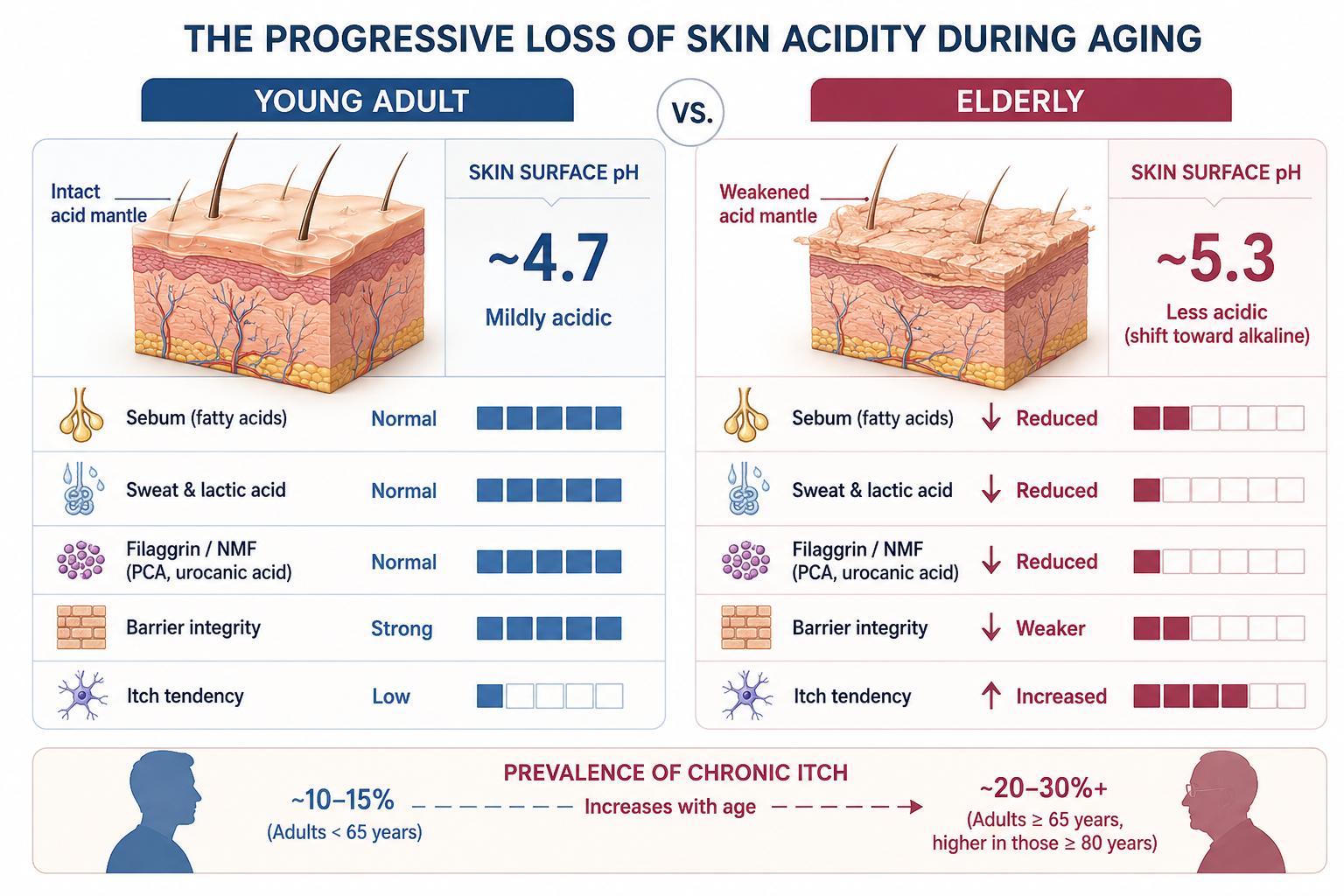
Chronic itch is one of the most prevalent and least discussed conditions of older age. Estimates place its prevalence at 20 to 30 percent of adults over 65, and higher still in those over 80. Most patients receive a diagnosis of xerosis — dry skin — and a recommendation to moisturize. Many do. Many continue to itch.
The dryness diagnosis is not wrong, exactly. Aged skin is drier, thinner, and structurally less resilient than younger skin. But dryness is a symptom, not an explanation. The more precise question is: why does aging skin lose its capacity to hold water, repair its barrier, resist pathogens, and maintain sensory equilibrium? The answer, increasingly, points to a single upstream disruption that cascades into all of the above.
Aging skin becomes less acidic. And that shift — gradual, logarithmically consequential, and almost entirely overlooked in clinical practice — may be the organizing biochemical event behind much of what we call age-related itch.
A Number That Changes With Age
In healthy adult skin, the surface equilibrates at a mildly acidic pH of approximately 4.7. Lipid-processing enzymes that build the barrier operate optimally in this range. Protease systems that could otherwise destroy the barrier are held in check. Commensal microbes that defend the skin are ecologically favored. The acid mantle, a thin protective film, sustains this environment continuously, buffering against alkalinizing perturbations from water, cleansers, and the environment.
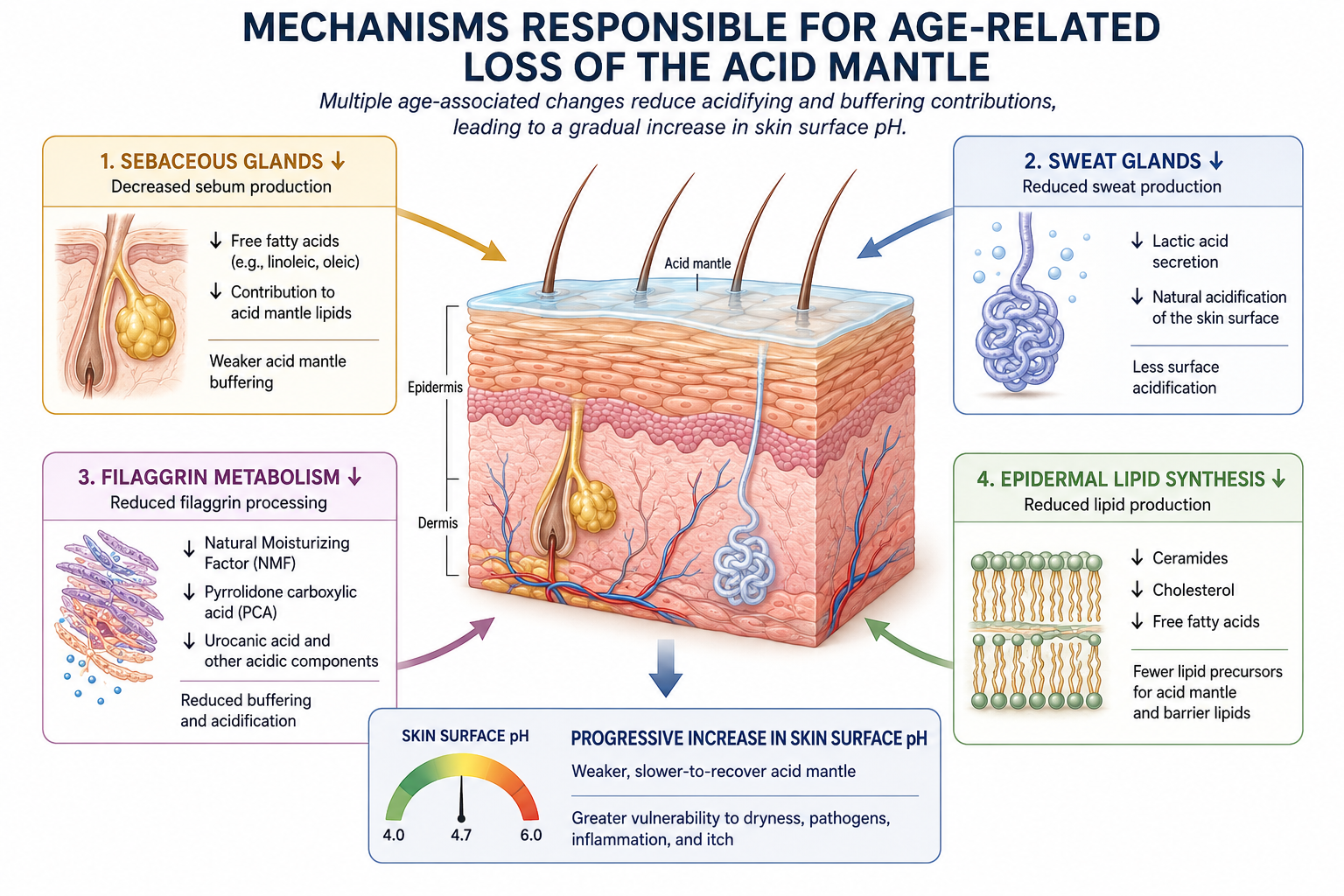
With advancing age, this system erodes. Sebaceous gland output declines, reducing the fatty acid contribution to the acid mantle. Sweat production falls, removing a significant source of lactic acid. Filaggrin processing slows, diminishing the supply of pyrrolidone carboxylic acid, urocanic acid, and other NMF constituents that acidify and buffer the stratum corneum. Lipid synthesis decreases broadly. Each of these changes individually would reduce acidifying flux; together, they produce a progressive, largely irreversible upward drift in surface pH.
The magnitude matters. Even a shift of 0.3 to 0.5 pH units — the kind documented in comparative studies of aged versus younger skin — represents a substantial biochemical change. Aged skin also re-acidifies more slowly after washing or barrier disruption, meaning the duration of alkaline exposure at the surface is prolonged relative to younger skin. The acid mantle becomes weaker, slower to recover, and increasingly unable to sustain the conditions that epidermal homeostasis requires.
“Aging skin does not simply become dry. It becomes progressively less acidic — and that biochemical drift impairs the barrier, favors pathogens, and sensitizes the sensory system in ways that routine moisturization does not address.
”
How An Alkaline Shift Breaks Down The Barrier
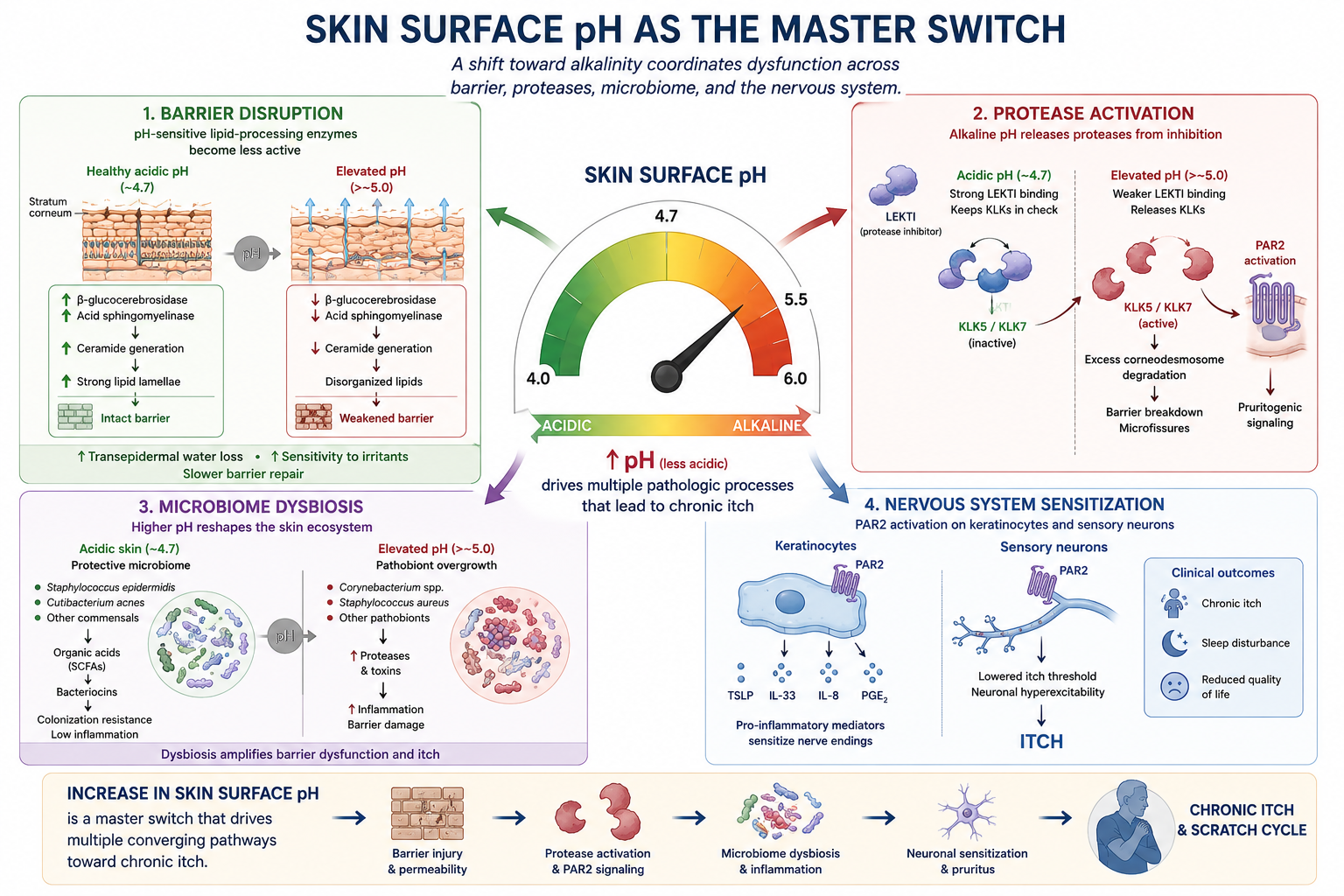
The permeability barrier of the stratum corneum is built from a lipid matrix — ceramides, cholesterol, and free fatty acids — organized into multilamellar bilayers that seal the extracellular space between corneocytes. This structure prevents water from leaving and irritants from entering. It is not assembled passively; it requires enzymatic processing of lipid precursors, and those enzymes are pH-sensitive.
Two are central: β-glucocerebrosidase, which converts glucosylceramides to ceramides, and acidic sphingomyelinase, which processes sphingomyelin into ceramide. Both function optimally under acidic conditions. As skin surface pH rises with age, their activity declines. Ceramide generation becomes incomplete. The lamellar bilayers that seal the barrier become disorganized. Barrier recovery after injury — whether from washing, friction, or environmental insult — slows. Aged skin already shows reduced total ceramide content and altered lipid ratios; elevated pH compounds these deficits by impairing the enzymatic machinery responsible for replenishing them.
The clinical consequences are familiar: increased transepidermal water loss, persistent xerosis, roughness, heightened sensitivity to mild irritants, and a reduced capacity to recover from minor insults. But the deeper consequence is that a structurally fragile stratum corneum exposes nerve endings in the viable epidermis to stimuli that healthy, intact skin would exclude. The sensory threshold for itch drops — not because the nervous system has changed, but because the structural barrier that normally filters environmental input has failed.
The Kallikrein–PAR2 Axis: How pH Turns Barrier Failure Into Itch
Barrier fragility is compounded by a second, directly pH-driven mechanism: the release of serine protease activity in the stratum corneum. Kallikrein-5 (KLK5) and kallikrein-7 (KLK7) regulate the orderly shedding of corneocytes through controlled breakdown of corneodesmosomes — the protein structures that hold cells together. Under acidic conditions, their activity is restrained by LEKTI, an endogenous protease inhibitor whose binding affinity for the kallikreins is pH-dependent. As pH rises, LEKTI inhibition weakens. KLK5 and KLK7 activity increases. Corneodesmosomes are degraded prematurely and excessively. Stratum corneum cohesion declines. Microfissures form, further increasing permeability.
This matters for itch through a direct molecular pathway. KLK5 activates protease-activated receptor 2 (PAR2) on keratinocytes and cutaneous sensory neurons. PAR2 signaling triggers the release of thymic stromal lymphopoietin, prostaglandin E2, and IL-8, and directly excites pruriceptive nerve fibers. The result is itch that is not inflammation-dependent — it is protease-dependent. In aging skin, where pH elevation is chronic and progressive, this PAR2 pathway operates continuously at a low level, contributing to baseline itch even in the absence of visible dermatitis.
“ In aging skin, elevated pH does not just weaken the barrier. It activates protease signaling that directly stimulates itch-sensing neurons — independent of inflammation, independent of allergens, and independent of the degree of visible skin damage.”
The Microbiome Shifts When the pH Shifts
The skin surface of younger adults is ecologically dominated by organisms adapted to acidic conditions: Cutibacterium acnes and Staphylococcus epidermidis metabolize sebaceous lipids and amino acids to produce organic acids that reinforce acidity, competitively exclude pathogens, and provide antimicrobial compounds — bacteriocins and lantibiotics — that selectively suppress pathogenic competitors. The acid mantle and the commensal microbiome are mutually sustaining: host biochemistry supports the commensals; commensal metabolism reinforces the acid mantle.
With aging, this ecosystem shifts. Sebaceous lipid availability declines, reducing the metabolic substrate that sustains C. acnes and S. epidermidis. As commensal abundance falls and pH rises, alkalinity-tolerant organisms — Corynebacterium species, and in compromised skin, Staphylococcus aureus — expand into the ecological space. S. aureus produces proteases, superantigens, delta-toxin, and PSM peptides that directly damage the barrier, activate keratinocyte alarmin release, stimulate Th2 immune polarization, and drive itch through both V8 protease-PAR1 signaling and direct immune activation.
The relationship between pH and the microbiome runs in both directions. Elevated pH favors the organisms whose products elevate pH further — through protease-driven barrier damage and the loss of commensal acid production. Dysbiosis and alkalinization are mutually reinforcing, and in aging skin they develop slowly in tandem, each making the other progressively worse.
“The acid mantle and the commensal microbiome sustain each other. When pH rises with age, commensals lose their ecological foothold, pathogens expand, and the microbial system that once reinforced acidity becomes a source of inflammation instead.”
Immunosenescence and the Inflammatory Background
The pH-driven changes in barrier and microbiome unfold against a background of age-related immune remodeling. Immunosenescence — the progressive restructuring of immune function with age — is characterized by reduced naive T and B cell populations, expanded memory and senescent immune cells, and a chronic low-grade inflammatory state termed "inflamm-aging." This persistent pro-inflammatory baseline lowers the threshold at which sensory neurons are recruited into itch signaling.
Several cytokines implicated in chronic itch, particularly IL-31, are dysregulated in older adults with chronic pruritus of unknown origin. Mast cell functionality also changes with age, altering histamine and neuropeptide release in ways that may lower the activation threshold for cutaneous sensory neurons. In this environment, the protease activity, barrier fragility, and microbial imbalance driven by pH elevation interact synergistically with immune-derived mediators — each amplifying the sensitivity of the sensory system to stimuli that would not provoke itch in younger, biochemically intact skin.
Neuroimmune Sensitization: When Itch Becomes Self-Sustaining
Chronic pruritus in older adults frequently presents without primary rash or visible dermatitis — a clinical pattern that reflects progressive neuroimmune sensitization rather than acute inflammatory disease. Age-related neural changes include altered intraepidermal nerve fiber density, increased peripheral nerve excitability, and reduced inhibitory signaling in itch-processing circuits. These changes lower the baseline threshold for itch perception and promote spontaneous pruriceptive firing.
The chronically elevated pH of aging skin maintains a protease-permissive environment that continuously activates PAR2 on sensory neurons, contributing to this sensitized state. Cytokines including IL-31, together with neuropeptides such as substance P and calcitonin gene-related peptide (CGRP), further lower activation thresholds and promote central sensitization — a state in which itch signaling becomes partially independent of peripheral input.
Scratching completes the cycle. Mechanical disruption of an already-fragile barrier increases transepidermal water loss, delays re-acidification, and prolongs the alkaline surface conditions that sustain protease activity and microbial imbalance. The itch-scratch-barrier cycle in aging skin is not simply a behavioral problem — it is a biochemical one, driven and maintained by a pH environment that no longer supports the regulatory systems that would otherwise interrupt it.
“In older adults, itch is not simply a symptom of dry skin. It is the sensory expression of a progressively destabilized biochemical interface — one that sustains protease signaling, favors pathogenic microbes, and sensitizes the nervous system through mechanisms that routine moisturization does not reach.”
Restoring Acidity: What the Evidence Says
The therapeutic logic of restoring physiological skin surface acidity in aging skin is straightforward: normalize pH, recover enzyme function, restrain proteases, recalibrate the microbiome, and reduce the biochemical inputs that sustain neuroimmune sensitization. The challenge, as in atopic dermatitis, is execution — specifically, the distinction between transient acidification and sustained pH correction.
Long-term clinical studies using acidic emollients in nursing home populations have demonstrated measurable improvements in barrier function, surface hydration, and skin pH compared to neutral formulations. Kilic and colleagues showed that a water-in-oil emulsion adjusted to pH 4 restored disrupted epidermal barrier function and improved lamellar lipid structure in elderly subjects — improvements attributable to the recovery of acid-dependent ceramide-processing enzyme activity. These findings align with mechanistic studies demonstrating that acidification enhances lamellar lipid organization, suppresses KLK5 and KLK7 activity, and reduces PAR2-driven inflammatory and pruriceptive signaling.
The requirement for sustained rather than transient acidification applies here as it does in AD. Low-molecular-weight acids such as dilute acetic acid can briefly lower a pH measurement without providing meaningful buffering capacity in the physiological range. Aged skin, which re-acidifies slowly after perturbation, is particularly vulnerable to prolonged alkaline drift between applications. Effective pH-corrective formulations for this population require buffering systems centered near pH 4.7, with molecular architecture that supports surface retention and resistance to neutralization across the full time course between applications.
Avoidance of alkaline-pH cleansers and soaps — which can transiently raise skin surface pH by several units and take hours to fully normalize in younger skin, and longer in aged skin — is a complementary and underutilized component of management. The mechanical act of washing is a repeated alkaline challenge; the formulation used matters considerably.
A Systems-Level View of Itch in Aging Skin
Age-associated pruritus is not a single-mechanism problem. It emerges from the convergence of lipid depletion, acid mantle erosion, protease overactivation, microbial dysbiosis, immunosenescence, and progressive neural sensitization — each contributing to and reinforcing the others. What makes skin surface pH compelling as a therapeutic target is not that it is the only driver, but that it sits upstream of all of them simultaneously.
Restore and sustain physiological acidity, and you simultaneously recover ceramide synthesis and lamellar lipid organization; suppress KLK5 and KLK7 activity and reduce PAR2-driven pruriceptive and inflammatory signaling; create ecological conditions that favor commensal dominance and suppress pathogenic expansion; and reduce the biochemical inputs that sustain neuroimmune sensitization. No symptomatic intervention — no antihistamine, no emollient, no topical steroid — addresses all of these dimensions at once, because they are not primarily symptomatic phenomena. They are biochemical ones.
Skin surface pH in aging skin is not a cosmetic parameter. It is a physiological one — and its gradual, progressive rise over decades is one of the more consequential and least-addressed features of the aging integument. The itch that results is real, chronic, quality-of-life-impairing, and biochemically tractable.
Correcting the pH — precisely, sustainably, and within the range where the biology actually works — is where a rational therapeutic strategy for age-associated pruritus begins.
Selected References