Your Eczema Treatment Is Working Even If It Doesn't Look Like It
Why the treatments that work fastest often don't last, and why the ones that last often take time to show it.
Author: Dr. Rafal Pielak
Most people with eczema know the rhythm by heart. A flare arrives: the itch, the redness, the sleepless nights. You treat it. It fades. And then, weeks or months later, it comes back. If this is your experience, you haven't failed at treating your eczema. You may simply be treating it incompletely.
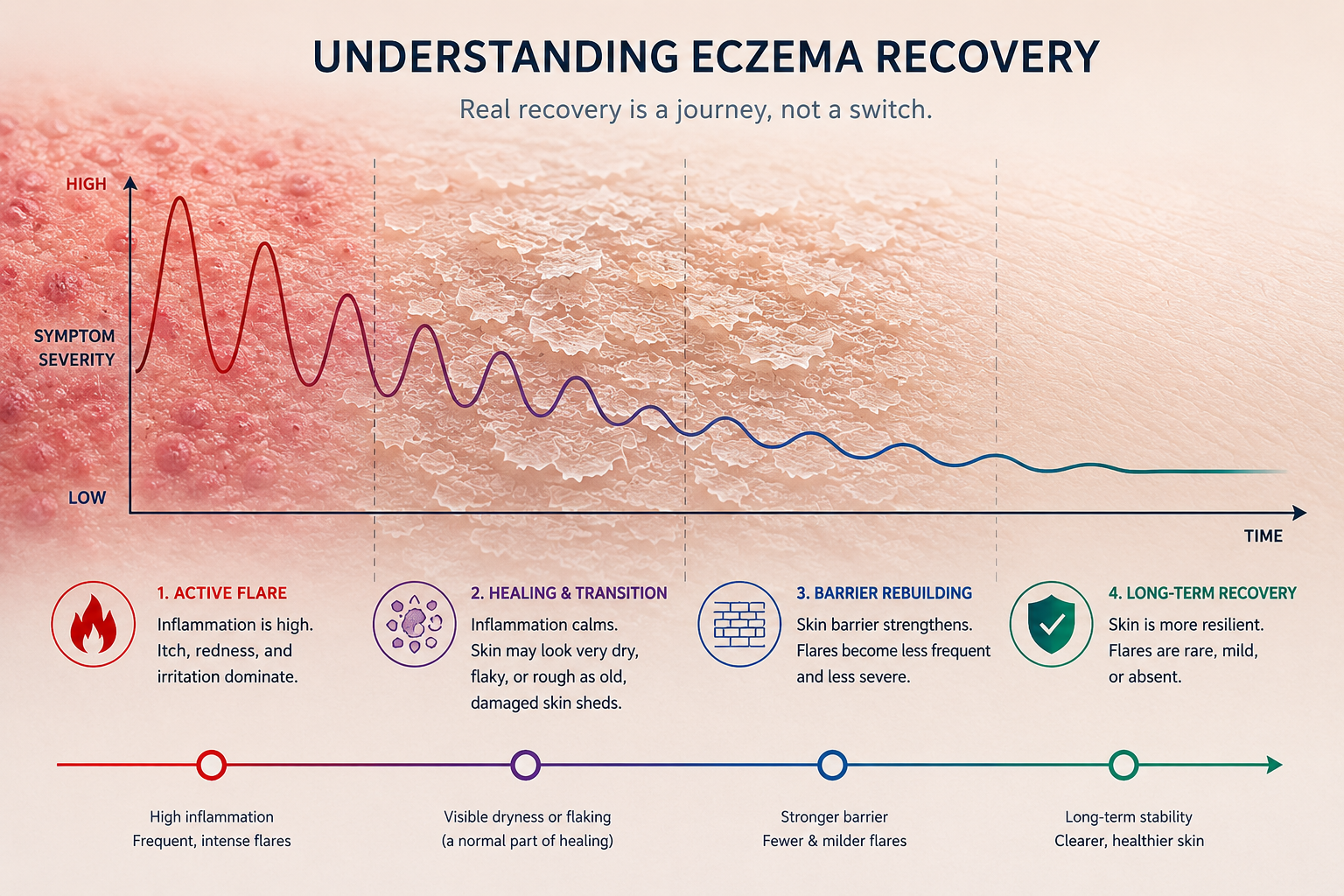
Real eczema recovery is not a straight line. It is not the absence of all symptoms starting next week. It is a gradual shift that unfolds over months, not days, in which flares become less frequent, less severe, and less defining of daily life. Understanding what that process actually looks like is essential for successful eczema treatment.
The Cycle You Know — And Why It Keeps Repeating
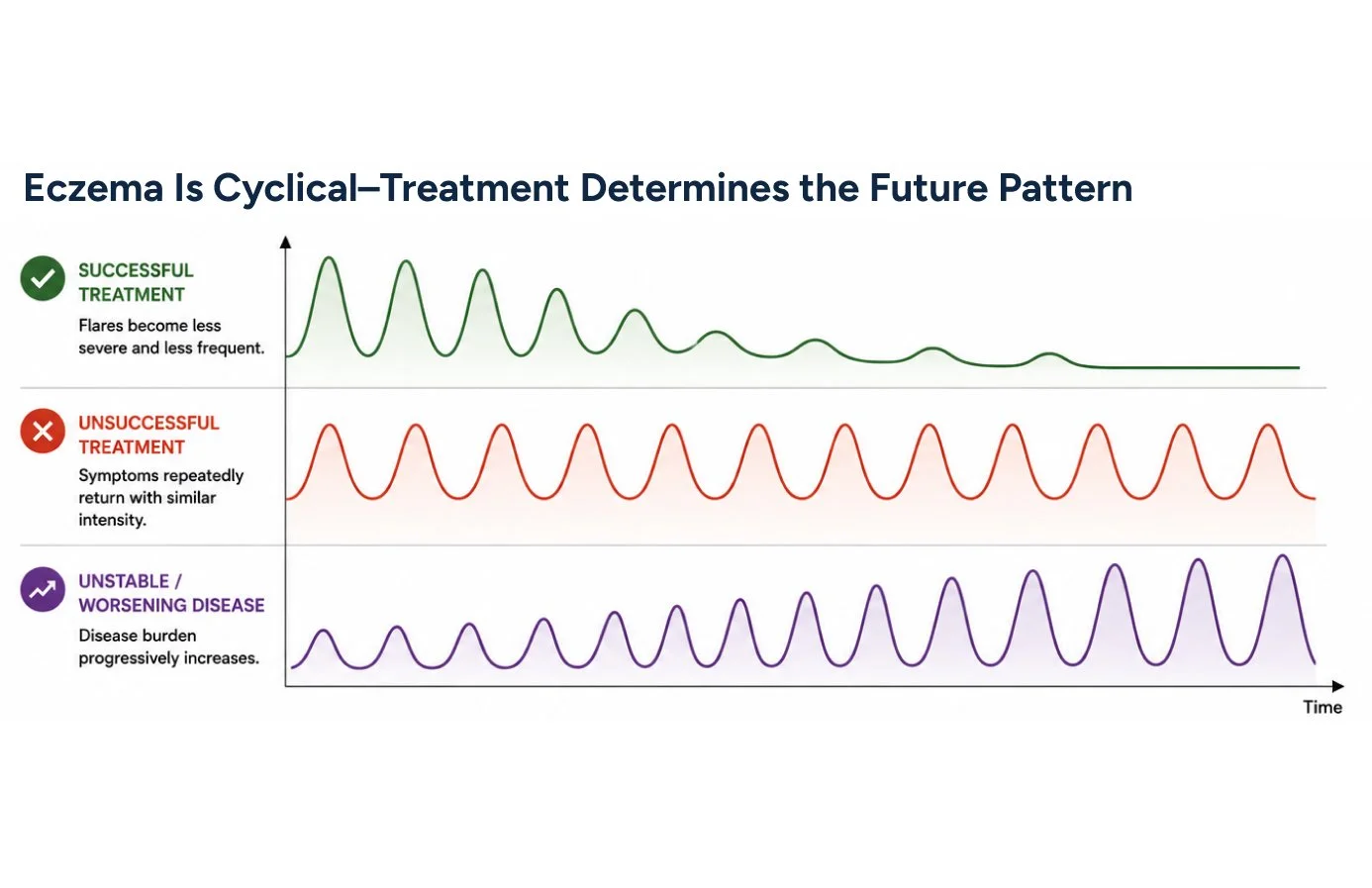
Atopic dermatitis is a chronic, relapsing-remitting condition, meaning that periods of active disease naturally alternate with periods of relative calm. Think of eczema as a waveform. In an uncontrolled or poorly managed course, the waves stay high and frequent: flares arrive with similar intensity, one after another, with limited relief between them. In an unstable disease course, one that is genuinely worsening, both the severity of each flare and the frequency of episodes increase over time, each cycle compounding the damage of the last.
“Successful treatment does not just relieve the current flare. It gradually reduces how often flares occur, how severe they are, and how long they last.”
This distinction between suppressing a single flare and genuinely changing the disease course is the heart of what real eczema recovery looks like. And it explains why a treatment that provides rapid symptom relief may still be leaving the underlying problem completely unaddressed.
Fast Relief Is Real — But It Isn’t The Whole Story
Topical corticosteroids are among the most commonly used eczema treatments, and for good reason: they are potent anti-inflammatory agents that can quickly calm an active flare, reduce redness, and interrupt the itch-scratch cycle. Used correctly, they are effective and safe, and they remain an important part of the management toolkit.
But there is a critical limitation to understand. Steroids suppress the immune response in the skin. They do not restore the structural and biochemical integrity of the skin barrier that made the skin vulnerable in the first place. When the course ends, the barrier remains compromised and the conditions that triggered the flare are still present. The cycle begins again.
This is why, for many patients, steroids work every time and yet the eczema never really goes away. Each new flare responds to treatment. Each new flare also comes back. The waveform remains high and repetitive. The disease is being managed, but it is not being changed.
Fast relief, in other words, is not the same as real recovery. Recognizing the difference is the first step toward achieving the latter.
Something Looks Worse — But The Skin Is Actually Healing
As inflammation comes under control, patients often enter a transitional phase that catches them off guard. The redness fades, the oozing stops, the itch decreases, and then the skin becomes noticeably dry, flaky, or rough. Many people interpret this as a worsening of their condition, or as evidence that the treatment is not working.
In many cases, the opposite is true.
When inflammation subsides, the skin's natural turnover process, which had been disrupted during the flare, begins to recover. As it does, the outer layer of dead and damaged skin cells starts shedding more actively. This accelerated renewal can look like dryness or scaling. It is not necessarily deterioration. It is often the first visible sign that the skin is beginning to rebuild.
The signal to pay attention to is inflammation, not surface texture. If the redness and intense itch of the active flare are diminishing, that is a meaningful positive signal, even if the skin still appears dry or uneven.
The Upstream Problem That Most Treatments Miss
To understand why some treatments fall short of lasting recovery, it helps to understand where eczema actually begins.
The skin's surface is protected by a thin acidic film known as the acid mantle. In healthy skin, the acid mantle maintains a pH between 4.5 and 5, with an optimal average of around 4.7. This acidity is not incidental. It is the master regulator of virtually every protective function the skin performs: it governs the enzymes responsible for natural skin shedding, controls the synthesis of ceramides and structural lipids, supports the antimicrobial properties of the skin surface, and shapes the ecology of the commensal microbiome that keeps harmful bacteria, including Staphylococcus aureus, in check.
In eczema, the acid mantle is consistently disrupted. As skin pH rises toward neutral, a cascade of downstream dysfunction follows: barrier enzymes become overactive and degrade the skin's structural proteins; ceramide production falls; S. aureus colonization expands, present on up to 90% of eczematous skin; and the barrier becomes progressively more permeable to allergens and irritants. Inflammation is the eventual result, but it is not the starting point.
“Most conventional treatments begin at inflammation, the downstream consequence. Restoring the acid mantle means addressing the upstream cause.”
This is the rationale behind the pH/LOCK® platform at Soteri Skin. Rather than starting at the inflammatory surface, pH/LOCK® targets the acid mantle itself, working to restore the skin's surface pH toward its physiologically optimal range and, in doing so, correcting the upstream conditions that drive barrier dysfunction, protease dysregulation, microbiome disruption, and chronic inflammation.
By reconstituting the acid mantle, a pH-restorative approach aims not merely to suppress the current flare but to reestablish the conditions under which the skin can maintain its own integrity. This is the difference between suppression and restoration.
The Smartest Strategy: Control The Fire, Fix The Foundation
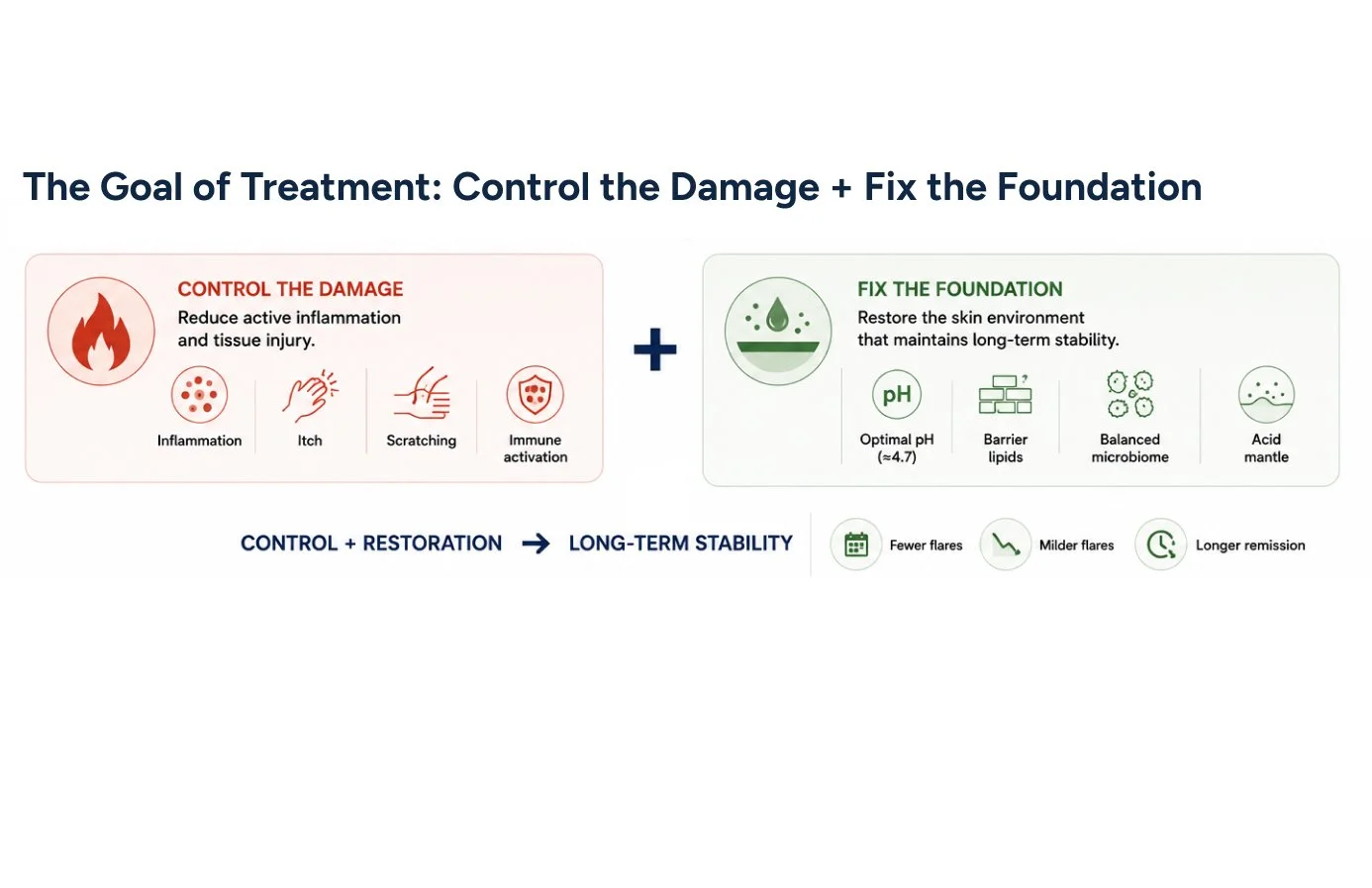
For patients with active or moderate-to-severe disease, the most effective path is not a choice between fast relief and lasting recovery. It is using both approaches together.
The skin during an active flare is in a state of active injury: inflammation is compounding barrier damage, the itch-scratch cycle is self-perpetuating, and the window for genuine healing is limited. In that context, anti-inflammatory therapy is not merely symptom management. It is damage control. It reduces the immunological burden on the skin and creates the conditions under which restoration can begin.
At the same time, a pH-restorative treatment addresses the conditions that made the flare possible. As inflammation is controlled and the acid mantle begins to recover, the downstream cascade normalizes: protease activity decreases, ceramide production resumes, the microbiome rebalances. The structural foundation for durable barrier integrity is progressively rebuilt.
One approach manages the crisis. The other addresses the cause. Together, they shift treatment from reactive to restorative.
Real Recovery Takes Time. Here Is What Is Happening Beneath The Surface
This is the stage that separates transient symptom suppression from genuine recovery, and it requires the most patience.
Long-term improvement in eczema is defined by a progressive reduction in both the frequency of flares and their severity. Months into consistent, well-directed treatment, flares should arrive less often. When they do arrive, they should be milder, shorter in duration, and easier to manage. Quiet periods between flares should lengthen. This is the biological signature of a disease being genuinely brought under control.
The reason this takes time is rooted in biology, not in any failure of the treatment. Skin renewal is an inherently slow process. The barrier renewal cycle takes around three to four weeks. Even as renewal begins, the skin is not yet fully resilient and remains susceptible to triggers that would not affect healthy skin.
The immune system adds another layer of delay. Chronic eczema involves an immune response that has been in a state of persistent activation, sometimes for years. That overreactivity does not resolve quickly. As the skin barrier gradually improves and the frequency of inflammatory triggers decreases, the immune system begins to recalibrate, but this process unfolds over months, not weeks. Barrier recovery and immune calming reinforce each other, but both take time.
This kind of improvement almost never materializes in the first few weeks of treatment. It typically requires two to three months of consistent therapy before the trend becomes clearly visible. The treatment horizon for real eczema recovery is measured in months, not days.
It is also important to understand that even as the overall trajectory improves, flares can still occur. The skin, even in recovery, remains sensitive to triggers: stress, allergen exposures, hormonal shifts, or even changes in temperature and humidity. A flare in the context of a well-directed treatment plan is not the same as the high-amplitude, repeating cycle of an uncontrolled disease. It is the skin responding to a challenge on a progressively stronger foundation.
“The question is not whether a flare occurred. It is whether it was milder than the last, and whether the interval since the one before was longer.”
These are the real signals of progress. They are less dramatic than watching symptoms clear in three days, but they are far more meaningful. They reflect a skin barrier that is becoming more resilient, an acid mantle that is being restored, and a disease that is being changed rather than merely managed.
What To Expect: A Realistic Recovery Timeline
Weeks 1–2. As pH correction begins and active symptoms are brought under management, inflammation starts to subside, itch reduces, and redness fades. As the inflammatory phase quiets, the skin may start to appear dry, rough, or flaky. This is not a setback. It is the first sign that the skin is beginning to shift toward repair.
Weeks 2–4. The barrier renewal cycle is underway. Since healthy skin takes around three to four weeks to complete one renewal cycle, this period reflects the skin actively rebuilding its structural foundation. As surface pH moves toward its optimal range, ceramide synthesis improves and the skin's natural enzyme activity begins to normalize. Dryness and some sensitivity are normal during this phase. As the barrier strengthens, it increasingly begins to regulate its own pH, reducing reliance on external correction.
Months 2–3. With fewer inflammatory triggers reaching the immune system, immune overactivity starts to calm. Flares should begin arriving less often and resolving more quickly when they do occur. This is where the combined effect of inflammation control and acid mantle restoration starts to become measurable.
Months 3 and beyond. Flare frequency continues to decrease. Severity diminishes. Quiet periods between flares lengthen. Skin resilience and hydration improve consistently. The overall trajectory is one of progressive stability rather than repeated crisis.
Long-term. A skin that no longer requires constant anti-inflammatory intervention, but benefits from consistent daily maintenance. Because genetics often contribute to eczema predisposition, maintaining a healthy acid mantle and a resilient skin barrier should become part of a permanent daily routine. The goal is not a cure but keeping the skin healthy and preventing symptom recurrence, rather than cycling back to disease and treating the symptoms reactively.
Eczema recovery is not about eliminating every symptom tomorrow. It is about changing the waveform, reducing the amplitude and frequency of a cyclical disease until the waves become manageable and, eventually, rare.
That requires patience, a treatment strategy that looks beyond immediate suppression, and an understanding that the skin's acid mantle is the right place to intervene for lasting change. It is the upstream regulator of barrier function, microbiome health, and immune response, and restoring it is what separates true recovery from the endless cycle of relief and relapse.
The information in this article is intended for educational purposes and does not constitute medical advice. If you have concerns about your skin health, please consult a qualified dermatologist.